 English
 Spanish
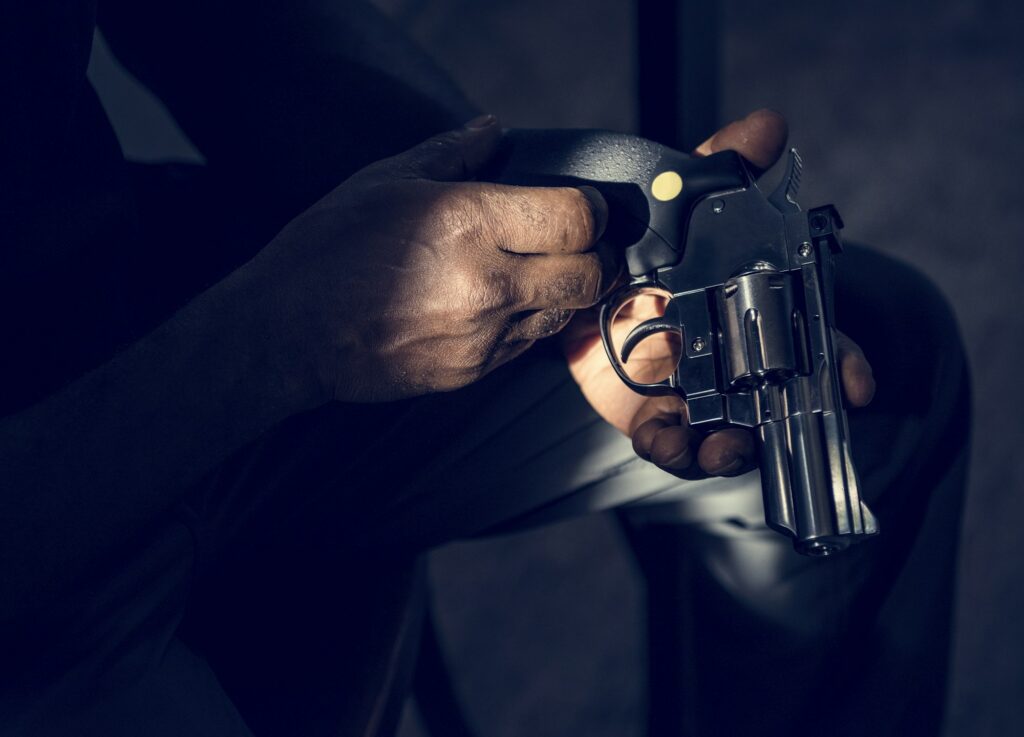
Have you wondered if you could face legal trouble for simply showing or brandishing a firearm in Nevada without actually firing it? While many believe that pulling the trigger is what draws legal attention, the act of displaying a firearm alone can lead to serious legal consequences. It’s important for gun owners to understand what constitutes “brandishing” and the potential legal outcomes.
Legal Definition of Brandishing a Firearm
Brandishing a firearm involves displaying a gun in a way that intimidates, threatens, or coerces someone. In Nevada, this can mean any action that shows a firearm in an aggressive or threatening manner, even if it is not pointed directly at someone or fired. According to Nevada Revised Statutes (NRS) § 202.320, brandishing a weapon is a misdemeanor offense, punishable by up to 6 months in jail and a fine of up to $1,000. However, if a firearm is pointed at another individual, the charge may escalate under NRS § 202.290, which can be classified as a gross misdemeanor, carrying up to 364 days in jail and fines up to $2,000.
It’s critical to note that a firearm does not need to be visible for someone to be charged. Simply stating that you have a gun, in a context meant to intimidate, can be enough for a charge. This reflects how seriously Nevada law treats the potential for firearms to incite fear or panic, even if no physical harm occurs.
Intent and Context: Key Factors in Brandishing Charges
Intent is a significant element in brandishing cases. Prosecutors must demonstrate that the accused displayed the firearm with the intent to threaten or intimidate. For example, lifting a shirt to reveal a holstered weapon during an argument can be considered brandishing if it’s interpreted as a threat.
The context in which the firearm is displayed is just as crucial. Situations involving heated confrontations or perceived threats can influence how law enforcement and the courts view an individual’s actions. The burden often falls on the defendant to prove that their actions were reasonable and justified—a point that underscores the complexity of claiming self-defense in such scenarios.
It’s worth mentioning that, even when claiming self-defense, the defendant must show that their response was necessary to prevent imminent danger. The law requires that the level of force used matches the perceived threat. For instance, if someone brandishes a firearm to dissuade an immediate physical assault, this context might provide a valid defense. However, this defense hinges on the circumstances, and misjudgment can still result in criminal liability.
Penalties and Consequences for Brandishing

The legal penalties for brandishing a firearm vary based on how the weapon was displayed and the perceived intent. As per NRS § 202.320, a basic brandishing charge is a misdemeanor, which can result in up to 6 months in jail and fines up to $1,000. However, under NRS § 202.290, pointing a firearm at someone escalates the offense to a gross misdemeanor, punishable by up to 364 days in jail and fines up to $2,000.
In more severe cases, brandishing can lead to further charges if it results in an altercation or injury. The prosecution may argue that the brandishing was part of a sequence of actions that included reckless endangerment or assault. This demonstrates the importance of understanding the potential ramifications before choosing to display a firearm, even if done defensively.
For those charged, the penalties don’t end at fines and jail time. A conviction can lead to a permanent mark on your criminal record, affecting employment, housing, and firearm ownership rights. This is why seeking the assistance of an experienced defense attorney is crucial for navigating these complex cases.
Self-Defense: When Brandishing Can Be Justified
Self-defense is a recognized legal justification for brandishing a firearm, but it comes with strict criteria. Under Nevada law, the use of a firearm in self-defense must meet the “reasonable person” standard—would a reasonable person in the same situation have perceived an immediate threat and acted similarly?
The “Castle Doctrine” in Nevada allows individuals to use force, including deadly force, without a duty to retreat when defending themselves in their homes. However, even under this doctrine, the force must be deemed necessary to prevent immediate harm. If the act of brandishing escalates the situation unnecessarily or is deemed disproportionate, the self-defense claim may not hold up.
Consulting case law can be informative. For instance, in State v. Weddell, the Nevada Supreme Court held that the defendant’s display of a firearm in a manner perceived as intimidating led to legal repercussions despite his claims of self-defense. This case underscores that the way a firearm is presented—along with the surrounding circumstances—can make the difference between a justified act and a criminal charge.
Steps to Take If Charged with Brandishing
If you are charged with brandishing a firearm, it’s vital to take immediate action:
- Contact a Defense Attorney: An attorney experienced in gun laws can help build your defense, explore potential evidence, and negotiate with prosecutors.
- Preserve Evidence: If there are witnesses or video evidence that support your claim of self-defense, ensure that this is documented and shared with your legal team.
- Avoid Self-Incrimination: Refrain from discussing the details of the incident with anyone other than your attorney. Anything you say could be used against you.
- Comply with Legal Orders: If any restraining or protective orders are issued, comply fully to avoid further complications.
The legal process can be complex, and having skilled representation is crucial for presenting a well-rounded defense. This is especially true in cases involving intent and context, where the perception of your actions can be pivotal.
Conclusion
Brandishing a firearm, even without firing it, can have serious legal consequences in Nevada. The key factors often boil down to intent, context, and the proportionality of your actions. While self-defense can serve as a legitimate defense, it must be well-founded and backed by evidence.
If you or someone you know is facing charges related to brandishing a firearm, contacting an experienced attorney is essential. At The Defense Firm, we specialize in navigating complex gun laws and building strong defenses tailored to your case. Contact us today for a free consultation and ensure that your rights are protected.