 English
 Spanish
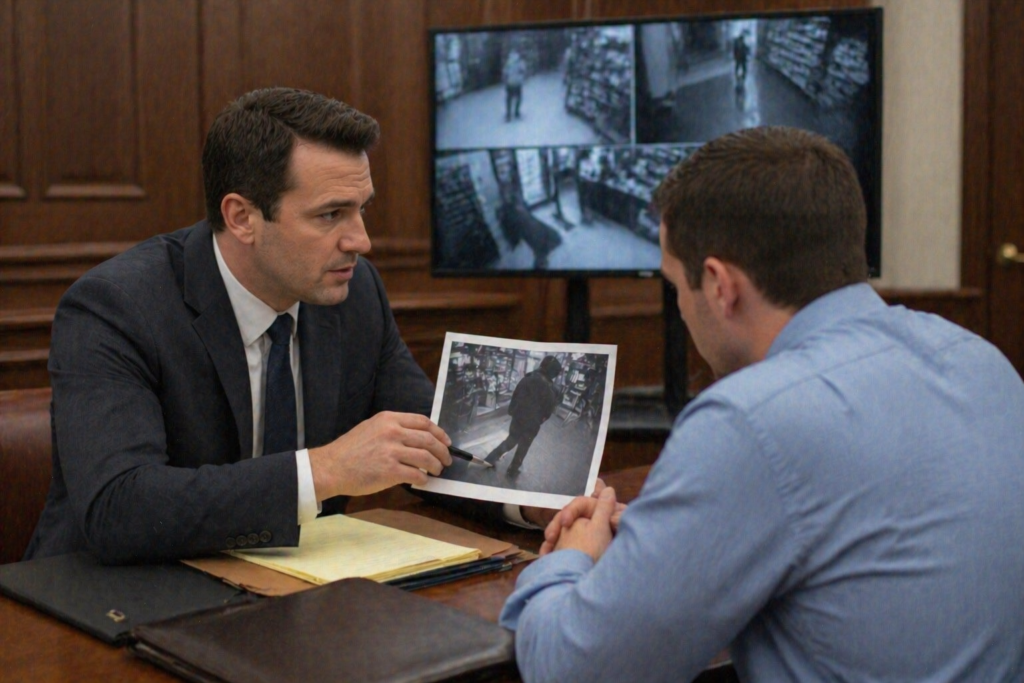
When someone is accused of theft in Nevada, one of the first things law enforcement and prosecutors reach for is surveillance footage. Retailers, casinos, apartment complexes, and parking structures throughout Las Vegas and Clark County operate dense networks of surveillance cameras, and in many cases, investigators believe they have a clear picture of what happened. What people facing these accusations often do not realize is that video evidence — no matter how seemingly clear — does not equal automatic guilt. Nevada law still requires the state to prove every element of a theft charge beyond a reasonable doubt, and that standard does not disappear simply because a camera was present.
The gap between being captured on camera and being convicted in court is wider than most people assume. Security camera footage is one form of physical evidence, but it is still subject to the same constitutional and evidentiary rules as any other proof the prosecution might attempt to use. Courts evaluate whether footage was lawfully obtained, properly authenticated, and whether it actually establishes what the prosecution claims it shows. An experienced criminal defense attorney knows how to scrutinize each of those questions, and in many Nevada cases, the answers open real opportunities to challenge or weaken the prosecution’s case.
Understanding this distinction early — before speaking to police, before making any statements — is critical to protecting your legal rights. Facing criminal charges based on camera footage does not mean the outcome is decided. It means the legal process is just beginning, and how you respond in the first hours and days will matter more than most people expect. The Defense Firm handles these cases across Nevada, and the insights below are meant to help you understand what is actually at stake.
Nevada Theft Law Requires More Than an Image on a Screen
Under Nevada law, a theft conviction requires the prosecution to prove several distinct elements, and video surveillance alone does not satisfy all of them. The state must establish that property was taken, that it belonged to another person, that the accused acted without consent, and — critically — that the person acted with criminal intent to permanently deprive the owner. That last element is where video-based theft cases frequently become complicated. A surveillance video can show a person picking up an item or leaving a store, but it cannot read the mind of the person shown. Intent is an internal state, and cameras do not capture it directly.
Circumstantial evidence fills in gaps that footage cannot answer, but it also introduces interpretation, which creates space for doubt. Prosecutors in Clark County and across Nevada often rely on assumptions drawn from what the video appears to show — an assumption that a particular person took a particular item with a particular purpose. Defense attorneys regularly challenge these assumptions by pointing to missing context: Was there an employee interaction off-camera? Did the person attempt to pay? Was there confusion about authorization? None of those possibilities are visible in a static or low-quality video clip, and the failure to prove intent beyond a reasonable doubt is a legitimate and recognized defense in Nevada courts.
Retail theft cases involving store cameras often compound this problem with image quality issues. Grainy footage, poor lighting in back corners of stores, or wide-angle lenses that distort distance make it genuinely difficult to identify individuals with certainty. The prosecution must establish probable cause for an arrest, but at trial, the burden shifts to proving guilt beyond a reasonable doubt — a much higher standard. A criminal defense lawyer who understands how to highlight these limitations can reframe what appeared to be definitive proof into something far less conclusive.
Chain of Custody and Proper Authentication Shape What Footage Can Do
Even when surveillance footage appears to clearly show an event, it must be handled and presented properly before it becomes usable as relevant evidence in a Nevada courtroom. The concept of chain of custody — the documented trail showing who collected, stored, and transferred the footage — is not a technicality. It is a constitutional safeguard. If law enforcement or a retail loss prevention team failed to preserve the footage correctly, altered the file, or cannot account for who had access to it between the incident and trial, that footage becomes vulnerable to exclusion.
Proper authentication is the second gatekeeping step. Before video evidence can be admitted, someone must testify that it accurately represents what it purports to show — that the timestamp was functioning correctly, that the camera was positioned properly, and that no editing occurred. Timestamps are a surprisingly common weakness in video-based accusations: studies have shown that a significant percentage of commercial security systems carry incorrect times due to daylight saving adjustments or setup errors. An inaccurate timestamp can create reasonable doubt about whether the footage corresponds to the time the alleged theft occurred, which can be fatal to the prosecution’s timeline.
Defense attorneys who handle these cases regularly will request full metadata for any video file, examine frame rates and compression artifacts, and may bring in expert testimony from forensic video analysts. These steps often reveal problems that a surface review would miss. At pre-trial hearings, a motion to challenge the admissibility of improperly handled footage — known as a suppression motion — can result in that evidence being excluded entirely. When footage is the centerpiece of the prosecution’s claims, suppressing it can fundamentally change the trajectory of the case.
Mistaken Identity Remains a Real and Defensible Problem in Theft Cases
One of the most under appreciated risks in video-based theft cases is mistaken identity. In high-traffic Nevada retail environments — particularly along the Las Vegas Strip, in large shopping centers, and in casino corridors — dozens or hundreds of people may pass through a given area within minutes. Unclear images captured at a distance, with obscured faces, partial obstructions, or similar clothing, make it genuinely possible for an innocent person to be misidentified as the individual who committed the alleged crime. This is not a hypothetical edge case; it is a documented pattern in criminal cases involving video.
Law enforcement often relies on a loss prevention officer’s identification of someone from footage — even when that officer has never seen the person in person. Courts have scrutinized this type of witness testimony and the standards it must meet. In Nevada, the reliability of an identification drawn from security camera footage can be challenged at trial by cross-examining how the identification was made, how many viewings occurred, and whether suggestive procedures influenced the outcome. The burden of proof remains with the prosecution, and a credible alternative explanation — that the accused was simply misidentified — can cast serious doubt on the case.
A criminal defense attorney defending against a theft accusation grounded in footage will systematically explore every angle of the identity question. This includes reviewing whether additional corroborating evidence actually confirms the identification or merely assumes it, whether body cam footage from responding officers is consistent with the initial report, and whether the alleged crime timeline matches the defendant’s confirmed whereabouts. Building this picture takes time and investigative work, which is why engaging legal counsel as early as possible — ideally before any formal charges are filed — gives the defense the strongest possible footing.
The Legal Process After a Theft Arrest in Nevada
When someone is arrested on theft charges in Nevada, the process moves through several predictable stages, each of which carries both risks and opportunities. After arrest and booking — which for many Clark County cases means intake at the county jail — an arraignment is scheduled where the accused formally hears the charges and enters a plea. Bail is typically set at this point, with the amount influenced by the severity of the theft allegation, the defendant’s ties to the community, and prior criminal record. Misdemeanor-level theft involves lower bail exposure, while felony-level theft charges — generally triggered when the value of stolen property reaches a statutory threshold — carry significantly higher stakes including potential jail time and a permanent record.
Between arraignment and trial, pre-trial hearings are where much of the real legal work happens. This is when defense attorneys file motions challenging the admissibility of video evidence, dispute the prosecution’s claims about probable cause, or argue that enough evidence does not exist to proceed. Suppression motions targeting improperly obtained surveillance footage are particularly significant because Nevada courts take Fourth Amendment protections seriously. If the footage was obtained without appropriate legal process, or if the chain of custody was compromised, a judge may rule it inadmissible — removing what is often the prosecution’s strongest asset.
Plea negotiations also occur during this window. Prosecutors in Nevada may offer reduced charges or alternative sentencing — including diversion programs that avoid a conviction and preserve the possibility of a cleaner criminal record — when the evidence has weaknesses. Understanding the strength or fragility of the prosecution’s case is something only an informed criminal defense lawyer can assess realistically. Making that assessment early, before accepting any offer or making any statements, is how people avoid outcomes that follow them far beyond the courtroom.
Defense Strategies That Address Video-Based Accusations Directly
Defending against video surveillance evidence in a Nevada theft case is not a matter of denying that cameras exist. It is a matter of applying rigorous legal analysis to what the footage actually proves — and what it does not. Defense strategies in these cases typically operate on several parallel tracks. The first is evidentiary: attacking the admissibility and reliability of the camera footage through chain of custody challenges, authentication disputes, and suppression motions. The second is interpretive: presenting an alternative explanation of what the footage shows that is equally or more consistent with innocence. The third is procedural: ensuring that law enforcement and prosecutors followed every required step correctly, because errors at any stage can affect what evidence is usable at trial.
Expert testimony from forensic video analysts has become increasingly important in these cases, particularly when footage quality is poor, when facial recognition assumptions are involved, or when timestamps are disputed. Experts can testify about what the footage can and cannot conclusively show, which directly undermines any claim that the video is definitive proof of guilt. Defense attorneys at The Defense Firm work with qualified forensic professionals when cases require that level of scrutiny, bringing the same depth of analysis to video-based accusations that they apply to any other form of physical evidence.
Ultimately, the goal of a well-executed defense in a theft case involving surveillance footage is to ensure that the jury or judge evaluates the evidence for what it actually is — one piece of a larger picture — rather than accepting it as self-evident truth. Criminal charges based on camera footage are serious, but they are not unbeatable. The legal process exists precisely to subject claims like these to adversarial scrutiny, and that scrutiny, applied by an experienced criminal defense attorney, is how outcomes are shaped in Nevada courts.
Taking Theft Charges Seriously Without Accepting a Presumption of Guilt
A theft accusation backed by video evidence can feel overwhelming, particularly when police and prosecutors present it as though the footage tells the whole story. It rarely does. Surveillance footage captures images, not context, and it captures moments, not motives. The distance between what a camera records and what the law requires the prosecution to prove is real, and experienced legal counsel knows how to work within that distance. Whether the issue is mistaken identity, a flawed chain of custody, an inability to prove intent, or footage that fails proper authentication, every one of these is a legitimate basis for a meaningful defense.
Firearm restrictions and other collateral consequences may also apply following a conviction, underscoring how seriously even what seems like a minor theft matter should be treated. Beyond that, a conviction — even for retail theft— can affect employment, housing applications, professional licenses, and immigration status for non-citizens. The full weight of what a permanent record means is not always clear at the moment of arrest, which is why understanding the specific circumstances of a case with qualified legal guidance matters so much. Acting quickly is not panic; it is a practical legal strategy.
This article provides general information about how video evidence is handled in Nevada theft cases. It is not legal advice, and outcomes depend entirely on the facts and specific circumstances of each case. Every situation is different, and nothing here should substitute for a direct conversation with a qualified criminal defense lawyer who can evaluate your matter in full.

FAQ
Can surveillance footage alone lead to a theft conviction in Nevada?
Video evidence can be used to support a theft conviction, but it is rarely sufficient on its own. Nevada courts require the prosecution to prove every element of theft beyond a reasonable doubt, including criminal intent — something footage alone cannot establish. Defense attorneys frequently challenge the reliability, admissibility, and interpretive assumptions behind video-based accusations. The outcome depends on the totality of evidence, not the existence of footage.
What happens after a theft arrest in Las Vegas?
After arrest, you will be booked and processed, typically at the Clark County Detention Center, and bail will be set based on the alleged value of stolen property and your criminal history. An arraignment follows, where formal criminal charges are read and you enter a plea. Pre-trial hearings are then scheduled, and this is when critical motions — including challenges to video evidence — can be filed. Contacting a criminal defense attorney before your arraignment significantly improves your ability to respond strategically.
Should I speak to the police about theft charges involving camera footage?
You have the right to remain silent, and exercising that right is almost always in your best interest before speaking with a lawyer. Statements made to police can be used against you, and in cases involving surveillance footage, anything you say about your presence, your actions, or your intent can be used to fill in gaps the footage alone cannot address. Politely declining to answer questions and requesting legal counsel is not an admission of guilt — it is a protected constitutional right.
What defense strategies work against video surveillance evidence in Nevada?
Experienced defense attorneys approach video-based theft cases through several strategies: challenging the chain of custody and proper authentication of the footage, filing suppression motions if the video was improperly obtained, raising mistaken identity arguments when the image quality is poor or identification uncertain, and using expert testimony from forensic analysts to challenge what the footage actually proves. The most effective strategy depends on the facts of each case.
How does mistaken identity affect theft cases based on camera footage?
Mistaken identity is a real and frequently documented problem in theft cases relying on security camera footage, particularly in high-traffic Nevada environments. If the footage is unclear images, taken from distance, or partially obstructed, the identification of a specific individual may be unreliable. Defense attorneys can cross-examine how an identification was made, challenge its reliability under Nevada evidentiary standards, and present corroborating evidence that supports an alternative explanation.
Conclusion
A theft accusation supported by surveillance footage is serious — but it is the beginning of a legal process, not the end of one. Nevada law places the burden of proof squarely on the prosecution, and that burden requires more than a video clip. The limitations of video evidence — its inability to prove intent, its vulnerability to chain of custody challenges, its susceptibility to mistaken identity errors, and its dependency on proper authentication — are real legal tools that a skilled criminal defense attorney can use on your behalf.
You do not have to navigate this alone, and you do not have to accept a presumption of guilt because a camera was present. People charged with theft charges in Las Vegas, Clark County, Henderson, and across Nevada have the right to a full defense, and that defense begins with understanding what the law actually requires. The sooner you get informed, the more options you have.
If you or someone you care about is facing criminal charges involving video evidence, reaching out to The Defense Firm for a free consultation is a calm, practical first step. Our team handles these cases across Nevada and is ready to help you understand your options, protect your rights, and explore every path forward.