 English
 Spanish

Checkpoints go up around every major Nevada holiday, and Independence Day weekend brings more of them than almost any other date on the calendar. Officers plan the locations weeks ahead, and drivers on the Strip, in Henderson, and on the highways feeding Lake Mead run into orange cones and flashing lights they didn’t expect.
Your DUI checkpoint rights in Nevada come from two different legal sources. One is a federal constitutional ruling that makes checkpoints lawful. The other is a Nevada statute that spells out what a checkpoint has to look like. Most guides blend the two together, but this one keeps them separate, because knowing which rule comes from where is what lets you spot a checkpoint that’s cutting corners.
We at The Defense Firm built this guide around three specific moves. The first is checking whether the setup matches what Nevada law requires. The second is knowing which test you can decline and which one carries a penalty. The third is understanding why a bad U-turn can create the exact suspicion you were trying to avoid. Anyone facing a DUI charge that started at a checkpoint should read this before a court date, not after.
Nevada DUI Checkpoint Requirements Under NRS 484B.570
Nevada spells out how an administrative roadblock has to be built in NRS 484B.570. The statute sets four physical requirements officers have to meet before they can wave a single car into the checkpoint lane. The roadblock itself has to sit where approaching traffic can see it. Warning signs need to stand well ahead of the stop on the highway shoulder, paired with a STOP placard near the centerline.
The roadblock must be visible to approaching traffic from 100 yards away. The STOP sign must be readable from the centerline at a distance of 50 yards, and a red flashing or intermittent light must also be visible from 100 yards. Warning signs must be placed approximately one quarter mile before a rural checkpoint and 700 feet before an urban checkpoint.
None of these numbers show up by accident. NRS 484B.570 limits the reasons police can set up a roadblock at all, excluding checkpoints run to identify who’s in a vehicle or thrown together because of an unrelated emergency. A checkpoint missing its warning signs, or one an officer improvised on the spot without following this setup, hands a defense attorney an opening. That’s the first detail we check when a DUI stop at a checkpoint leads to charges.
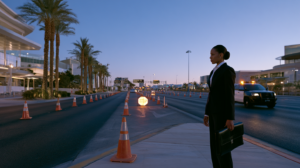
The Constitutional Rules Governing DUI Checkpoints
Nevada’s statute governs what a checkpoint looks like. A separate line of federal case law governs whether checkpoints are constitutional at all under the Fourth Amendment, and that’s where Michigan Department of State Police v. Sitz, 496 U.S. 444 (1990), comes in. The U.S. Supreme Court upheld highway sobriety checkpoints by a 6-to-3 vote. The ruling applied a three-factor balancing test the Court had set out eleven years earlier in Brown v. Texas, 443 U.S. 47 (1979). That test weighs the public interest a checkpoint serves, how much the checkpoint advances that interest, and how far it intrudes on the drivers who pass through it.
Brown v. Texas matters here for a reason competitors’ posts skip. It’s also the case that explains why a checkpoint needs a supervisory officer planning it and a neutral, preset stopping pattern. Officers pull over every fifth car, for example, rather than picking vehicles at the scene by hunch. A stop based on nothing but an officer’s gut read risks the arbitrary enforcement Brown v. Texas flagged as unconstitutional.
Sitz found that a checkpoint planned and applied the same way to every driver who passes through tips the balance toward the state’s interest in getting impaired drivers off the road. That’s the constitutional floor beneath every checkpoint in Nevada, separate from the signage rules in NRS 484B.570. Our post on DUI checkpoints in Las Vegas and what rights drivers actually have covers the driver conduct side of the stop once the constitutional and statutory pieces are in place.
Preliminary Breath Tests, Evidentiary Tests, and Field Sobriety Tests
Two different tests can come up at a Nevada checkpoint, and they carry two different consequences. The preliminary breath test, the handheld device an officer might ask you to blow into at the roadside, is voluntary in most circumstances. Nothing in NRS 484C.160 forces you to take it, and declining it doesn’t trigger an automatic license penalty on its own. An officer can still use other signs, including slurred speech, the smell of alcohol, or an open container, to develop probable cause for an arrest without it.
NRS 484C.160, Nevada’s implied consent statute, applies once an officer has reasonable grounds to believe a driver is impaired. It holds that anyone driving on a Nevada highway has already agreed to a blood, breath, or urine test, though that obligation begins after an arrest, not at the checkpoint stop itself. Refusing the evidentiary test at that point triggers a one-year license revocation under NRS 484C.210, rising to three years for a second refusal within seven years. That revocation runs through the DMV independently of whatever happens in the criminal case. An officer who can’t get a breath sample can also request a telephonic warrant for a blood draw, and Nevada law permits reasonable force to complete that draw once a judge signs off.
Field sobriety tests, including the walk and turn, the one-leg stand, and the eye tracking check, sit in the same voluntary category as the preliminary breath test. Declining one is not, by itself, an admission of anything, although officers note a refusal in their report and may still develop probable cause from what they already observed. Our guide on field sobriety tests in Nevada covers how officers score these tests and where the scoring runs into trouble. If a refusal already cost you your license, our breakdown of what happens after you refuse a breathalyzer in Nevada walks through the DMV hearing that follows.
Legal Detours and Illegal U-Turns Near a Checkpoint
Spotting a checkpoint ahead doesn’t lock you in. If a legal turn, side street, or parking lot entrance sits between you and the checkpoint, you can take it. Nevada law doesn’t punish a driver for choosing a different lawful route rather than passing through a sobriety checkpoint.
An illegal U-turn is where that protection ends. Swerving across a double yellow line, cutting through a closed lane, or making an unsafe turn to dodge the checkpoint gives an officer an independent basis, apart from the checkpoint, to pull you over. That’s ordinary traffic stop law, the same reasonable suspicion standard that applies to any moving violation, and it has nothing to do with whether the checkpoint itself was lawful. A driver who breaks a traffic law to avoid a checkpoint ends up in the exact stop they were trying to skip, except now an officer has watched them commit a violation first.
Three Moves That Protect Your Rights at a Nevada DUI Checkpoint
Put the three pieces together, and you get a practical process to follow before an officer reaches your window. First, observe the checkpoint setup and determine whether it appears to comply with NRS 484B.570, including visible warning signs, proper lighting, and a clearly marked STOP sign. Second, understand the difference between a preliminary breath test, which can generally be declined, and an evidentiary test requested after an arrest, which can carry serious license consequences if refused. Third, if you decide to avoid the checkpoint, use a lawful alternate route rather than making an illegal or unsafe turn that gives officers an independent reason to stop you.
Out-of-state visitors may face additional complications because they are driving on unfamiliar roads, passing through an unfamiliar checkpoint, and often using a rental vehicle. If the stop results in a DUI charge, the case may need to be handled from another state, while the observations made by the officer at the checkpoint become part of the arrest report and the prosecution’s evidence.
A checkpoint that fails to meet Nevada’s statutory requirements, or an officer who expands the stop beyond what the law permits, may create grounds to challenge the detention and any evidence obtained afterward. The defense can examine the checkpoint plan, signage, stopping pattern, officer conduct, body camera footage, and the reason the encounter developed into a DUI investigation.
If the stop leads to an arrest or a driver’s license suspension, the criminal case and the DMV proceeding must be addressed separately. Understanding what to say, what not to volunteer, and how quickly to request review of the license action can help preserve important defense options.

FAQ
Does Nevada require advance public notice of a DUI checkpoint?
Law enforcement agencies release a checkpoint’s general date, time, and area through local media before setting one up, and many departments treat that notice as standard practice. NRS 484B.570 itself does not impose a public notice requirement. The statute’s requirements are the physical signage and lighting standards drivers see once they’re near the roadblock, not advance publicity.
Is refusing a breath test at the checkpoint the same as refusing after an arrest?
No, a preliminary breath test offered at the checkpoint itself is voluntary in most circumstances, and declining it carries no automatic DMV penalty. The evidentiary test required after an arrest under NRS 484C.160’s implied consent rule is different. Refusing that test triggers a license revocation through NRS 484C.210, separate from the underlying DUI case.
Can missing checkpoint signs lead to a DUI case being dismissed?
It can support a challenge. A checkpoint missing the visibility distances, STOP sign, or warning signs that NRS 484B.570 requires gives a defense attorney grounds to challenge the stop. Evidence gathered at a checkpoint that didn’t meet the statute can be suppressed, although whether that challenge succeeds depends on the specific facts of the stop. A review by a defense attorney matters before assuming a case is unwinnable.
Conclusion
A DUI checkpoint stop moves fast, and the decisions you make in the first minute, before an officer asks a single question, can shape what your case looks like afterward. The checkpoint setup, the officer’s stopping pattern, the questions asked, the tests requested, and the reason for extending the stop may all become important parts of the defense.
A checkpoint that fails to comply with Nevada’s statutory requirements, or an officer who expands a stop without a lawful basis, may create grounds to challenge the evidence. A defense attorney can review the warning signs, roadblock location, police reports, body camera footage, breath or blood testing procedures, and the separate DMV consequences tied to the arrest.
At The Defense Firm, we have reviewed checkpoint stops across Clark County for setup errors, procedural shortcuts, improper test requests, and violations of drivers’ constitutional rights.
Contact The Defense Firm today for a free confidential consultation. Let our attorneys examine how the checkpoint was operated, determine whether the stop complied with Nevada law, and begin protecting your license and your record before the case moves forward.