 English
 Spanish
Most criminal cases never reach trial. That matters because much of the anxiety surrounding a criminal case comes from imagining a process that many defendants ultimately never have to go through.
But if your case is moving toward trial, the sequence is knowable. Understanding what happens from pretrial preparation through verdict can make the process less confusing and help you identify which decisions belong to your lawyer, which belong to the court, and which are ultimately yours.
The court your case is in changes what the trial looks like
The first issue is the court, because it affects how the trial proceeds. In district court, where felony cases are tried, a case that must be tried by jury generally proceeds that way unless the defendant waives a jury in writing, with court approval and the prosecutor’s consent.
In justice court, the rule is different. A defendant generally must demand a jury trial in writing at least 30 days before trial, and missing that deadline can result in a bench trial instead. A defendant charged with a capital offense, however, must be tried by jury.
Most cases resolve before trial
For felony cases, the road toward trial usually includes a preliminary hearing, where the State must establish probable cause before the case can proceed into district court. Pretrial litigation follows, and motions such as a motion to suppress can determine what evidence the prosecution will be allowed to present. In Clark County, certain written pretrial motions generally must be filed at least 15 days before trial, subject to applicable exceptions.
This is also when many cases resolve through dismissal or negotiation rather than trial. Trial preparation and plea discussions often occur at the same time, with defense counsel preparing witnesses, reviewing evidence, and filing motions while continuing to evaluate whether a negotiated resolution is in the client’s best interest.
Calendar call determines whether the trial is actually going forward
Shortly before the scheduled trial date, the court may hold a calendar call, where the parties tell the judge whether the case is ready for trial, needs to be continued, or has been resolved. A scheduled trial date is therefore not always the date the trial will actually begin, because witnesses, discovery issues, unresolved motions, and court scheduling can cause the case to move.
That uncertainty has practical consequences for work, travel, childcare, and witness availability. A first trial setting may be continued more than once, so defendants should take every date seriously while understanding that their lawyer may advise against assuming the first setting is guaranteed to hold.
Jury selection comes first in a jury trial
If the case proceeds before a jury, the trial begins with jury selection. Nevada criminal juries ordinarily consist of 12 jurors, although the parties may agree in writing before jury selection, with court approval, to proceed with fewer than 12 but generally not fewer than six.
Prospective jurors are questioned to determine whether they can fairly and impartially decide the case. Both sides may seek removal of jurors through challenges for cause and a limited number of peremptory challenges, subject to constitutional restrictions. The process may take only part of a day in a simple case or considerably longer in a complex or high-profile prosecution.
Opening statements explain what each side expects the evidence to show
After the jury is selected, the parties generally give opening statements. The prosecution usually goes first, while the defense may give its opening immediately or reserve it until later depending on strategy and court procedure.
An opening statement is not evidence. It gives each side an opportunity to explain what it expects the evidence to show, allowing the prosecution to outline its theory of the case while the defense can identify anticipated weaknesses, inconsistencies, missing evidence, or questions the jury should keep in mind.
The State presents its evidence first
The State’s case comes first because the prosecution carries the burden of proving the charges. Prosecutors call witnesses and introduce exhibits, while defense counsel can cross-examine those witnesses and challenge the reliability, credibility, foundation, chain of custody, or consistency of the evidence presented.
Police reports, laboratory records, photographs, videos, and other documents generally must be admitted through the proper evidentiary process rather than simply handed to the jury. The defense can use cross-examination and objections to test how those records were created, what they actually prove, and whether they support the prosecution’s version of events.
The defense does not have to present evidence
After the prosecution rests, the defense may present witnesses, documents, expert testimony, or other evidence, but it is not required to do so. The burden of proof never shifts to the defendant, and a defense strategy may consist entirely of cross-examining the State’s witnesses and arguing that the prosecution failed to prove one or more elements beyond a reasonable doubt.
Whether to present affirmative defense evidence depends on the facts and strategy of the individual case. The decision about whether the defendant personally testifies is separate and belongs to the defendant, who should make it after discussing the risks and potential benefits with counsel.
Closing arguments and jury instructions come after the evidence
Once the evidence is complete, both sides make closing arguments, explaining how they believe the testimony and exhibits should be interpreted. Unlike opening statements, closing arguments can directly address the evidence that actually came into the courtroom and highlight conflicts, weaknesses, credibility problems, or reasons the State has or has not met its burden.
The judge also provides jury instructions explaining the legal standards that control the case, including the elements of the charged offenses and the burden of proof. The parties may dispute which instructions should be given, but the court determines the final instructions the jury must follow during deliberations.

The State must prove guilt beyond a reasonable doubt
Nevada law begins with the presumption of innocence, meaning the defendant is presumed innocent unless the prosecution proves guilt. That burden stays with the State throughout the trial, and the defendant does not have to prove innocence or provide an alternative explanation for the alleged offense.
Nevada also provides a statutory definition of reasonable doubt, describing it as a doubt based on reason rather than a merely possible or imaginary doubt. Jurors must decide whether, after considering all the evidence, they have an abiding conviction in the truth of the charge, and Nevada law does not permit courts to substitute their own alternative definition of that standard.
The verdict must be unanimous
After closing arguments and jury instructions, the jury deliberates, and a Nevada criminal verdict must be unanimous. If all jurors agree that the prosecution failed to prove the case, the defendant is acquitted. If all jurors agree on guilt, the case proceeds to sentencing.
If the jury cannot agree unanimously, it may result in a hung jury and mistrial rather than an acquittal. Because no final verdict has been reached, the prosecution may generally have the option to retry the case, negotiate a resolution, or dismiss the charges.
A mistrial is not the same as an acquittal
An acquittal is a final determination that the prosecution failed to prove guilt, and the defendant generally cannot be retried for the same offense. It ends the criminal prosecution on that charge.
A mistrial caused by a hung jury is different because the jury did not reach a verdict. The State may therefore generally choose whether to retry the case, negotiate another resolution, or dismiss it depending on the strength of the evidence and the circumstances surrounding the first trial.
Some of the most important trial decisions belong to the defendant
Defense counsel manages many strategic and procedural decisions, but several of the most consequential choices belong to the defendant personally. These include whether to testify, whether to waive a jury trial when the law permits it, and whether to accept or reject a negotiated plea agreement. A lawyer can advise the client, but cannot make those decisions on the client’s behalf.
Speedy-trial rights can also involve meaningful strategic choices because requesting a faster trial can limit preparation time for both sides. These decisions interact with the evidence, charges, criminal history, potential sentencing exposure, and overall defense strategy, which is why they should be discussed with counsel well before trial whenever possible.
How long does a Clark County criminal trial take?
There is no universal timeline. A relatively straightforward misdemeanor trial may take a single day, while a felony trial can last several days or longer. Cases involving numerous witnesses, expert testimony, forensic evidence, digital records, or complicated legal disputes can take substantially more time.
The actual trial is often shorter than the period leading up to it. Defendants may spend months dealing with hearings, discovery, motions, negotiations, and continuances before jury selection begins, so the lawyer who has reviewed the specific case is in a much better position to estimate its likely duration than any general timeline.
What the courtroom is actually like
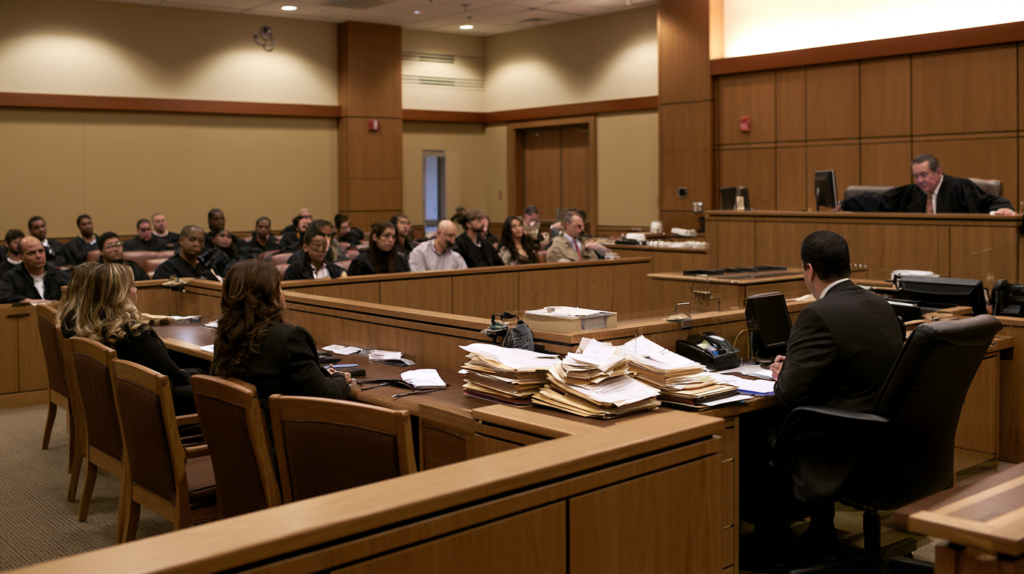
A criminal courtroom is usually much less dramatic than television suggests. The judge presides from the bench, the jury sits in the jury box, attorneys and the defendant sit at counsel tables, and members of the public remain in the gallery. A defendant who is not in custody generally sits beside defense counsel rather than separately.
The pace can also be slower than expected because objections, sidebars, recesses, evidentiary arguments, and discussions outside the jury’s presence regularly interrupt the presentation of evidence. Jurors can observe the defendant throughout the proceeding, so counsel may also provide specific guidance about appearance, reactions, posture, and courtroom conduct.
How jurors evaluate the evidence
Jurors do not evaluate every witness and exhibit in complete isolation. They consider credibility, consistency, and the overall coherence of the prosecution’s case, comparing testimony with physical evidence, documents, video, expert opinions, and other information admitted during trial.
The defense does not necessarily need to prove an entirely different version of events. In many cases, the defense focuses on showing gaps, contradictions, unreliable witnesses, missing evidence, or unanswered questions that prevent the prosecution’s story from satisfying the beyond-a-reasonable-doubt standard.
Frequently Asked Questions
What happens if the jury cannot reach a unanimous verdict?
Nevada requires a unanimous criminal verdict. If the jury cannot agree, the court may declare a mistrial because of a hung jury. That is not an acquittal. The State may generally choose to retry the case, negotiate a resolution, or dismiss it depending on the circumstances.
Why does my Las Vegas trial date keep getting moved?
Continuances are common. Trial dates can change because of witness availability, unresolved motions, discovery issues, negotiations, court congestion, or scheduling conflicts. A moved trial date does not necessarily mean something has gone wrong. It often reflects the normal realities of preparing and scheduling a criminal case.
Can a Nevada criminal trial have fewer than 12 jurors?
Yes, in limited circumstances. Nevada generally provides for 12 jurors, but the parties may agree in writing before jury selection, with court approval, to proceed with fewer jurors, generally no fewer than six. One side cannot simply impose a smaller jury on the other.
Conclusion
The criminal trial process in Las Vegas follows a recognizable sequence: pretrial preparation, calendar call, jury selection, opening statements, the State’s evidence, the defense case if one is presented, closing arguments, jury instructions, deliberation, and verdict.
But the way that sequence applies to your case depends on the court, the charges, the evidence, the motions already filed, and several decisions that belong to you personally.
If your case is moving toward trial in Clark County, contact The Defense Firm for a free confidential consultation. A Las Vegas criminal defense lawyer can explain where your case currently stands, what issues still need to be resolved before trial, and what decisions you may need to make as the case moves forward.