 English
 Spanish
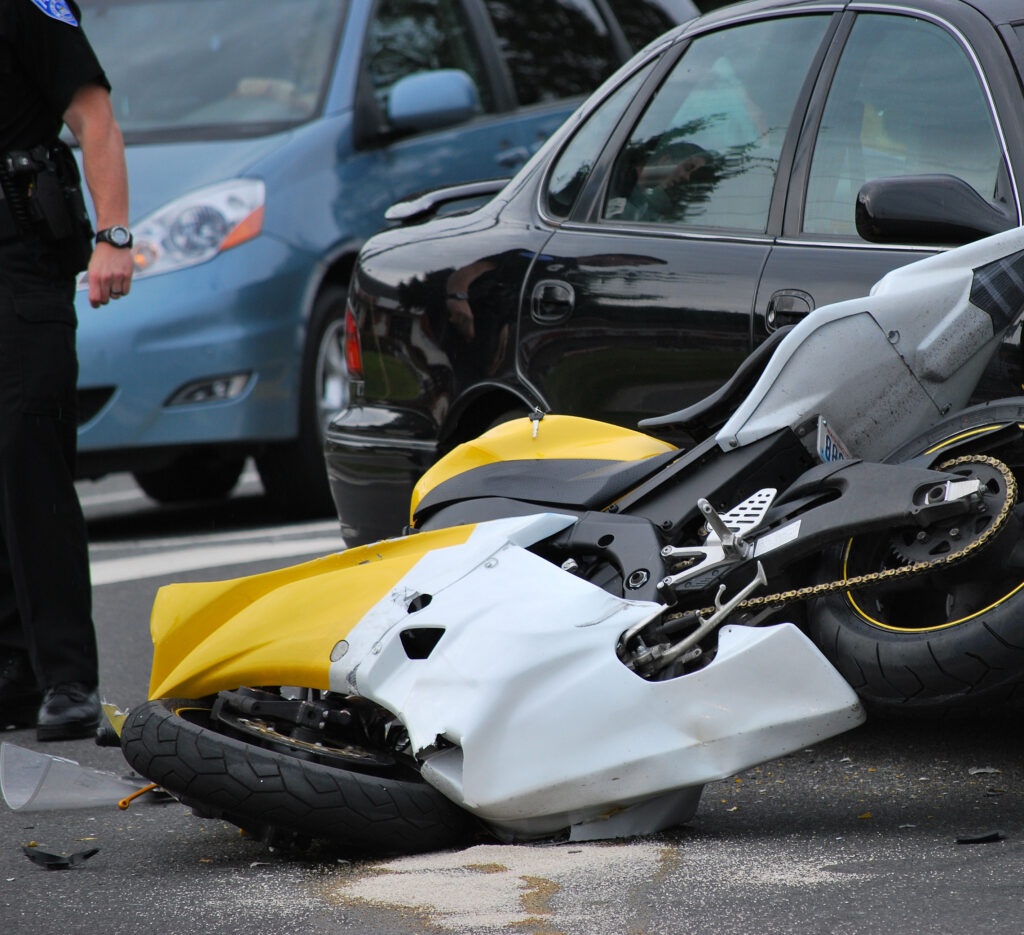
Motorcycle riders in Nevada face a level of physical exposure that passenger car occupants never experience. Despite representing less than 3% of registered vehicles on Nevada highways, motorcyclists account for nearly 24% of all traffic fatalities statewide — a disparity that reflects the complete absence of structural protection separating a rider from impact. According to Nevada Department of Public Safety data, the state recorded 82 motorcycle fatalities in 2024 alone, making it the fourth-deadliest year on record for traffic fatalities overall. Clark County — home to Las Vegas — bore more than 70% of those deaths, a concentration driven by high traffic volume, tourist-heavy roadways, and complex urban intersections where other drivers routinely fail to see or yield to approaching riders.
Understanding the reality behind motorcycle deaths vs. car deaths matters not only for rider safety but for anyone who may face legal consequences after a crash. Whether you are a rider asserting your right to seek compensation, a driver confronting criminal charges, or a family navigating sudden loss, the legal landscape in Nevada moves quickly. The decisions made in the hours immediately following an accident — what to say, what to preserve, and who to call — can determine the outcome of everything that follows.
Fatal Crash Statistics That Confirm a Severe and Widening Risk Disparity
National Highway Traffic Safety Administration Data Shows an Alarming Trend
The National Highway Traffic Safety Administration recorded 6,335 motorcyclist fatalities nationally in 2023 — the highest total ever documented, representing a 26% increase since 2019. Per 100 million vehicle miles traveled, motorcyclists die at a rate of approximately 31.39, compared to just 1.13 for passenger car occupants. That difference — roughly 28 times higher per mile — is not a statistical quirk. It reflects the fundamental vulnerability of riding without airbags, crumple zones, and seat belts. Fatal motorcycle crashes account for 15% of all U.S. traffic fatalities while motorcycles make up only 3% of total registered vehicles, a disparity that is widening because advances in car accident safety technology — autonomous braking, lane-assist systems, improved airbag placement — provide no benefit to riders.
Motorcycle crashes produce death or severe injuries in approximately 80% of reported incidents — four times the rate seen in collisions involving passenger vehicles. Car accidents remain the larger contributor to absolute death counts due to sheer volume, but no other category of motor vehicle accident carries the same per-incident lethality as a motorcycle crash. These figures matter because they directly shape how courts, insurers, and law enforcement approach fault determination and injury severity when motorcycles are involved — and they are routinely used by insurance companies to challenge the compensation claims of injured riders.
Nevada Stands Among the Most Dangerous States for Motorcycle Riders
Nevada has ranked consistently among the five most dangerous states for motorcycle travel, with motorcycle fatalities per 10,000 registered vehicles placing it in the top tier nationally. Speeding is a contributing factor in nearly 33% of fatal crashes in Nevada — the highest rate among high-risk states studied — while impaired riding appears in approximately 27% of fatal incidents statewide. These accident statistics reflect a state where the combination of a year-round riding season, high-speed desert highways, and tourism-driven impaired driving creates conditions that consistently produce fatal outcomes at disproportionate rates.
In the Reno and Sparks corridor of Washoe County, Interstate 80 and surrounding surface roads see significant motorcycle accident activity, particularly during summer months when riding volume peaks and road surface temperatures reach dangerous extremes. Nevada’s desert climate removes the natural seasonal reduction in motorcycle exposure that colder-weather states experience, keeping rider fatality rates elevated year-round. Inexperienced riders on high-displacement motorcycles, unfamiliar with road hazards unique to Nevada’s environment — sand accumulation on curves, flash-flooding debris, and tire-degrading heat — represent one of the fastest-growing risk categories tracked by state traffic safety officials.
Structural Differences That Drive the Injury Severity Gap Between Motorcycles and Cars
Brain Injuries and Spinal Damage Define the Most Catastrophic Motorcycle Crash Outcomes
When a motorcycle crash occurs, the rider’s body absorbs impact directly — against the pavement, fixed objects, other vehicles, or barriers — without the energy-redirecting structures that protect car occupants. Brain injuries account for nearly half of motorcycle fatality causes even when a motorcycle helmet is properly worn. IIHS data confirms helmets reduce death risk by approximately 37% and brain injury risk by 67%, meaningful numbers that simultaneously validate helmet use and expose its limits at highway speeds. Traumatic brain injury survivors frequently experience cognitive impairment, emotional dysregulation, and long-term disability that permanently disrupt employment, relationships, and independence in ways that far exceed the visible physical injuries.
Spinal injury is another defining consequence of motorcycle trauma that separates rider outcomes from those of car drivers in comparable crashes. Ejection from a motorcycle at speed can produce compression fractures, disc ruptures, or severed spinal connections resulting in permanent paralysis. Car occupants, shielded by frame, airbag, and seat belt, are far more likely to sustain soft-tissue injuries like whiplash — painful and disruptive, but rarely catastrophic. The physical exposure inherent to motorcycle riding means that injury severity in crashes involving motorcyclists is consistently higher by every metric tracked by the National Highway Traffic Safety Administration and the Insurance Institute for Highway Safety.
Medical Costs and Lost Income Create a Secondary Crisis for Motorcycle Crash Survivors
The medical expenses associated with traumatic brain and spinal injuries regularly reach six figures and, in severe cases, extend into lifetime care costs that include rehabilitation, assistive technology, home modification, and round-the-clock personal support. Lost wages compound these burdens, particularly for riders whose physical occupations are no longer possible after injury. Car occupants involved in comparable crashes — protected by structural safety features — statistically experience shorter hospital stays, faster recovery timelines, and lower rates of permanent disability, producing a measurably lower overall financial burden even when the crash itself was equally violent.
For Nevada motorcycle riders, this financial reality intersects directly with the legal process. Insurance claims following severe injuries frequently become adversarial: carriers routinely argue that motorcycle riders bore partial responsibility for their own injury severity, citing accident statistics about rider behavior to reduce payouts on medical bills, lost income, and personal injury protection benefits. Maximum compensation for genuine fatal injuries and permanent impairment requires a documented, legally sound factual record — one built from police reports, medical records, and preserved digital evidence gathered as close to the crash as possible.
Contributing Factors Behind Fatal Motorcycle Crashes in Las Vegas and Clark County
Distracted Driving and Failure to Yield Create Lethal Conditions for Motorcycle Riders
Determining fault in multi-vehicle motorcycle crashes frequently implicates other drivers rather than the rider. NHTSA identifies left-turn collision scenarios — where a turning car driver fails to detect an approaching motorcycle — as one of the most documented fatal accident patterns in urban settings. Distracted driving, including mobile device use prohibited under Nevada law, amplifies this visibility problem. On Las Vegas arterial roads and Strip-adjacent corridors, where tourist drivers unfamiliar with local traffic laws share lanes with experienced commuters, inattentiveness and driver error combine with dense traffic to create intersections that are particularly lethal for riders.
Aggressive driving behaviors — rapid, unsignaled lane changes, tailgating, and red-light running — eliminate the margin for error that motorcycle riders rely on to stay safe. Because motorcycles represent a narrower visual target than passenger cars, any gap in surrounding driver attention can translate into catastrophic impact with no time for evasive response. Contributing factors documented at the scene — road hazards, lighting conditions, signal timing irregularities, and lane markings — all become part of the legal record and directly influence fault determination and recovery outcomes in Nevada proceedings.
Impaired Riding, Speeding, and Inexperienced Riders Compound the Fatality Risk
Impaired riding and speeding are documented risk factors attributable to riders themselves, not just car drivers. Nevada data shows approximately 27% of motorcycle riders in fatal crashes had blood-alcohol content exceeding the legal limit, while speeding appears in nearly one-third of statewide motorcycle fatalities. These behaviors carry direct criminal exposure: a rider who is impaired and involved in a crash causing death can face DUI charges, vehicular manslaughter prosecution, and a criminal record with consequences extending well beyond the immediate penalty. Driver error is not always on the other party’s side, and when evidence suggests rider conduct contributed materially to the collision, criminal and civil liability follow.
Inexperienced riders represent an increasingly documented risk category in Nevada, particularly within the Las Vegas metro. LVMPD officials have stated publicly that rider inexperience is a causal factor in the majority of local fatal motorcycle crashes. Nevada law currently allows motorcycle purchase without a valid Class M license, enabling undertrained individuals to operate high-powered bikes on public roads with minimal preparation. The resulting skills deficit — combined with road hazards unique to Nevada’s desert environment, including debris accumulation, flash flooding, and extreme-heat pavement deterioration — creates conditions that experience and training could help a rider survive but inexperience frequently cannot.
Nevada’s Motorcycle Helmet Law and Protective Gear Requirements
Nevada enforces a universal motorcycle helmet law requiring all riders and passengers to wear a DOT-standard motorcycle helmet at all times, regardless of age. This positions Nevada among only 17 states with comprehensive coverage requirements — a legal distinction that matters both for rider safety and for any civil claim that follows a crash. IIHS data confirms that helmet laws covering all riders produce dramatically higher compliance rates among fatally injured motorcyclists than partial or optional statutes. Failure to comply with Nevada’s requirement is not only a traffic violation — it can be raised in civil litigation as evidence that a rider’s own conduct worsened their brain injuries, potentially reducing compensation under the state’s comparative fault framework.
Protective gear beyond the helmet — reinforced riding jackets, gloves, abrasion-resistant pants, and ankle-protecting boots — is not legally required but is consistently associated with reduced injury severity in crashes occurring at urban speeds. Law enforcement and traffic safety advocates in Clark County regularly emphasize full gear use as the most accessible individual risk-reduction measure for riders who cannot control the attention, sobriety, or judgment of the car drivers around them. The data on fatal outcomes is consistent: gear reduces the consequences of a crash, even when it cannot prevent the crash itself.
Criminal and Legal Consequences After a Nevada Motorcycle Accident
DUI and Reckless Driving Charges Following a Crash Carry Serious Penalties
When a motorcycle accident results in serious injuries or a fatality, Nevada law enforcement investigates whether criminal conduct contributed. A rider or driver found impaired at the time of a crash can face DUI charges with penalties including jail time, significant fines, license suspension, and a criminal record that affects employment eligibility, housing, and professional licensing. If death results, charges can escalate to vehicular manslaughter, carrying potential state prison sentences under Nevada law. Reckless driving under NRS 484B.653 — defined as willful or wanton disregard for the safety of persons or property — is another serious charge prosecutors pursue when evidence of extreme speeding, red-light violations, or aggressive driving is documented in the police reports.
Felony charges arising from a motorcycle crash carry consequences that extend far beyond any immediate sentence. Depending on the circumstances, a conviction can affect professional licenses, immigration status, access to housing, and long-term lost income potential. The burden of proof in a criminal case rests with the prosecution, and an experienced Nevada criminal defense attorney can challenge whether evidence was lawfully obtained, whether police reports accurately reflect what occurred at the scene, and whether the alleged conduct truly satisfies the legal threshold for criminal recklessness. Early legal involvement — ideally before any formal statement is made to investigators — is the most effective protection available.
Fault Determination, Insurance Claims, and Recovering Compensation After a Crash
Nevada follows a modified comparative negligence standard, meaning determining fault in a motorcycle accident involves assigning a percentage of responsibility to each party involved. If a rider or driver is found 50% or more at fault, they are barred from recovering compensation under Nevada law entirely. This framework makes the early factual record — police reports, witness statements, traffic camera footage, and medical documentation — critically important to both criminal defense and civil recovery strategies. Evidence that is not preserved promptly after an accident can be permanently lost, weakening both a compensation claim and a defense against criminal charges.
Insurance claims following fatal injuries or serious injuries frequently become contested and adversarial. Carriers use car accident statistics and generalized data about motorcycle riders to challenge the severity and causation of claimed losses, reducing payouts on medical bills, lost wages, medical costs, and personal injury protection benefits wherever possible. Maximum compensation for a serious crash in Nevada requires a documented legal strategy built from the earliest available evidence. A legal team with experience in both the criminal defense and civil dimensions of Nevada motorcycle accident law is essential to protecting every right available under state law.

FAQ
Should I speak to the police at the scene of a motorcycle accident in Nevada?
You are legally required to stop, provide your identification, and exchange information after an accident in Nevada. Beyond those minimum obligations, however, you have the right to remain silent about the circumstances of the crash. Statements made voluntarily at the scene — even casual, well-intentioned ones — can be used against you in a subsequent criminal investigation or civil lawsuit. It is generally advisable to be cooperative with basic procedural requests while declining to speculate about fault, speed, or what happened before speaking with legal counsel. If law enforcement asks you to give a recorded statement, that is the moment to ask for an attorney.
What criminal charges can arise from a motorcycle accident in Nevada?
If law enforcement determines criminal conduct contributed to a crash, charges can range from misdemeanor reckless driving to felony vehicular manslaughter, depending on what occurred and whether injuries or fatalities resulted. DUI charges are common when alcohol or drug impairment is suspected, and Nevada law permits officers to request blood-alcohol testing at the scene. The severity of charges typically reflects the degree of negligence or recklessness involved and the seriousness of any injuries caused. An experienced Nevada criminal defense attorney can evaluate whether the evidence meets the applicable legal standard and identify grounds to challenge the charges filed.
When should I contact a lawyer after a motorcycle accident in Nevada?
The sooner the better — ideally within hours of a serious crash. Nevada’s statute of limitations for personal injury claims is generally two years from the date of injury, but critical evidence can disappear within days. If criminal charges are possible, having legal counsel engaged before you give any formal statement to investigators is especially important, as early statements frequently shape how a case develops at every subsequent stage. Even if you are uncertain whether charges are coming or whether you have a viable claim, a confidential consultation with The Defense Firm costs nothing and gives you clarity about your rights and options before you make decisions that cannot be undone.
Conclusion
Nevada’s roads are among the most demanding in the country for motorcycle travel, and the legal consequences that follow a serious crash are rarely straightforward or predictable. From Las Vegas to Henderson, from North Las Vegas to Reno, The Defense Firm represents individuals navigating the complex intersection of criminal charges, insurance disputes, and civil liability that a motorcycle accident can simultaneously trigger. Our team brings Nevada-specific knowledge, courtroom experience, and a client-focused approach to every case — whether a rider is facing unexpected criminal exposure, a driver is defending against charges arising from a collision, or a family needs guidance after a fatal accident.
If you or someone close to you has been involved in a motorcycle crash in Nevada, contact The Defense Firm for a confidential consultation. Protecting your case begins with understanding your rights, and the sooner you act, the more options remain available. You do not have to navigate this alone — and you should not try to.