 English
 Spanish

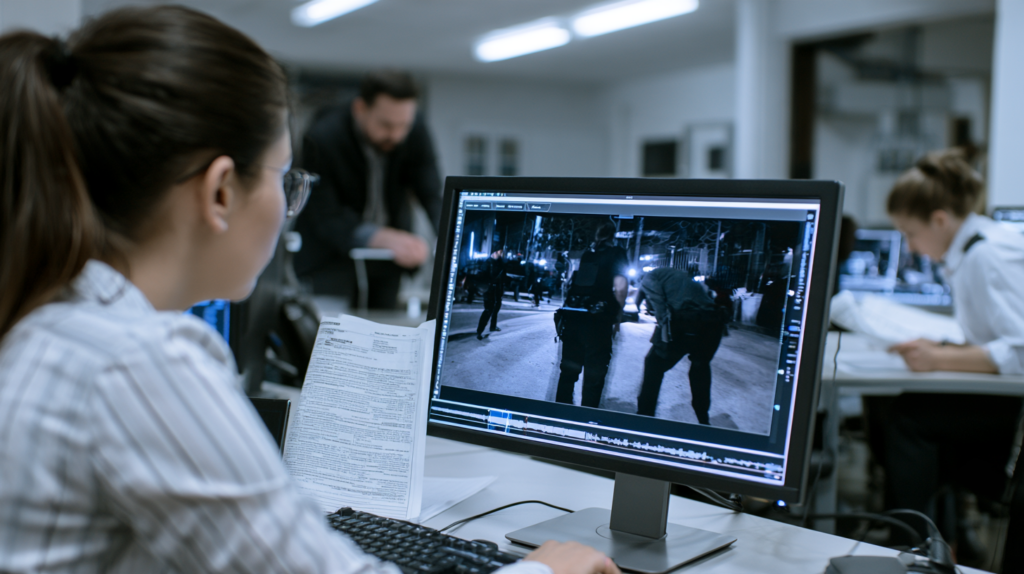
Body camera footage from a Las Vegas arrest does not necessarily remain available forever. Nevada law sets a minimum retention period, and once that minimum passes, footage that could support or contradict the prosecution’s version of events may no longer be available.
Knowing that a retention clock exists, and asking about the footage early, can be important in a Nevada criminal case.
Nevada requires body-worn cameras and sets a minimum retention period
NRS 289.830 requires certain law enforcement agencies to provide body-worn recording devices to uniformed peace officers who routinely interact with the public while on duty.
The statute also requires agencies to adopt policies governing how those cameras are used.
One of those required policies concerns retention. Nevada law requires video recorded by a body-worn camera to be kept for at least 15 days.
That 15-day period is a minimum, not a guaranteed deletion date.
An agency may keep footage much longer depending on its internal policy, the type of incident, and whether the recording has been connected to an active investigation or criminal case.
The practical concern is that Nevada law does not guarantee that every bodycam video will remain available indefinitely.
That is why defendants should raise the issue with counsel as early as possible.
Which Nevada agencies are covered?
The body-camera statute applies to several categories of law-enforcement agencies.
That includes metropolitan police departments such as LVMPD, along with county sheriff’s offices, city police departments, certain municipal court marshal operations, the Nevada Highway Patrol, and school district police.
The statute focuses specifically on uniformed peace officers who routinely interact with the public.
It does not necessarily mean that every employee or every officer performing every assignment is subject to the same body-camera requirement.
That distinction may matter when determining whether footage should have existed in a particular case.
Dashcam footage follows different rules
Bodycam footage and dashcam footage should not be treated as though Nevada law governs them identically.
NRS 289.830 defines the covered recording device as equipment issued to an officer to be worn on the body.
The statute does not impose the same statewide retention requirement on in-car dash cameras.
That does not mean dashcam footage is unavailable or unimportant.
It means the existence and retention of dashcam video may depend primarily on the individual law-enforcement agency’s own policies.
If a patrol-car video could matter to the defense, counsel should identify the department involved and determine what its policy requires.
When officers are supposed to activate body cameras
Nevada law also addresses when body cameras should generally be activated.
Agency policies must require activation when an officer responds to a call for service or begins another law-enforcement or investigative encounter with a member of the public.
The policies also generally prohibit the officer from deactivating the device before the encounter ends.
Those rules include legitimate exceptions.
Privacy considerations can affect recording inside a private residence, during interactions with someone reporting information anonymously, or when dealing with a person who claims to be a victim of a crime.
A gap in a recording therefore does not automatically mean the officer violated the law or intentionally concealed something.
The reason for the gap still may be worth investigating.
What happens if an officer violates the bodycam policy?
Nevada law requires agencies to create disciplinary rules addressing certain body-camera violations.
Those can include failing to operate the device according to agency policy, intentionally manipulating video, or prematurely deleting footage.
The consequences described by the statute are primarily internal disciplinary measures.
NRS 289.830 does not say that a violation automatically results in suppression of evidence, dismissal of charges, or exclusion of an officer’s testimony.
That means a body-camera violation can be important without automatically deciding the criminal case.
A defense lawyer still needs to determine what happened, why it happened, and how the missing or incomplete video affects the prosecution’s evidence.
Bodycam footage can be especially important in domestic violence cases
A domestic violence arrest often turns heavily on what officers observed and what the people involved said at the scene.
Bodycam footage can preserve tone, timing, visible conditions, statements, and the sequence of events that may later be reduced to only a few paragraphs in a police report.
That can be especially important in cases involving conflicting accounts or no visible injuries.
Video may show details that support the officer’s report, contradict portions of it, or provide additional context that the written narrative does not capture.
For that reason, footage from a domestic violence call should be identified and reviewed as early as possible.
Use-of-force and resisting-arrest cases can depend on the sequence of events
Bodycam footage can also become particularly important when the case involves use of force, resisting arrest, battery on an officer, or similar allegations.
Those cases can turn on timing.
Who moved first?
What commands were given?
Was the defendant given time to comply?
When did force begin?
What happened immediately before the physical encounter?
A police report provides a written narrative after the event.
Video, when available, may allow the defense to examine the sequence more directly.
That does not mean the footage automatically helps the defendant. It means the video and the written report should be compared rather than assumed to tell exactly the same story.
What bodycam footage can reveal that a police report may not
Several details are especially important when comparing body-camera footage with a written police report.
One is the stated reason for a stop or detention.
The video may help establish when that reason was communicated and whether the actual sequence matches the later written description.
Another is whether officers gave particular commands and when those commands occurred.
That can become important when the prosecution claims that someone refused to comply or resisted.
Footage can also provide a more direct record of an encounter involving force.
Written reports necessarily summarize events. Video can preserve details about timing, movement, tone, and context that may be difficult to reconstruct from a report alone.
Bodycam footage has limits
A video recording should not automatically be treated as a complete account of everything that happened.
The camera angle is limited to the perspective of the officer wearing the device.
It may not capture what another officer, witness, or defendant could see from a different position.
Activation timing can also create gaps.
Events that occurred immediately before the officer activated the camera may not appear at all.
Audio can also be incomplete because of equipment problems, environmental conditions, or legitimate deactivation under privacy-related rules.
The right approach is therefore not to assume that video tells the entire story, but to examine exactly what it captures and what it does not.
Getting bodycam footage through discovery
Nevada law treats body-camera recordings as public records but places limitations on how those records can be requested.
Requests generally must be made on a per-incident basis.
Some footage containing information that cannot adequately be redacted may be available only for inspection at the location where the agency keeps the record rather than provided as a copy.
For someone already facing criminal charges, the discovery process is usually a more important route.
Defense counsel can request relevant footage as part of the criminal case rather than relying solely on an ordinary public-records request.
That process can also provide context, including police reports, dispatch records, photographs, and other evidence connected to the same incident.
Because of the retention issue, the request should be raised early.
Why the 15-day rule creates urgency
The 15-day retention rule is sometimes misunderstood.
It does not mean every Nevada police department automatically deletes footage on day 16.
Many departments may retain video for much longer, particularly when it relates to an active criminal investigation or arrest.
The importance of the rule is that 15 days is the statutory minimum.
A defendant should therefore not assume that video will still exist months later merely because the criminal case remains pending.
Preservation and discovery requests can help make sure potentially important evidence is identified before an agency’s ordinary retention period expires.
Frequently Asked Questions
Is Las Vegas bodycam footage automatically deleted after 15 days?
No. Nevada law establishes 15 days as a minimum retention period, not a mandatory deletion date. An agency may retain footage significantly longer depending on its internal policy and whether the recording is connected to an active investigation or criminal case. The safest approach is still to request or preserve potentially relevant footage as early as possible.
What if my case involves dashcam footage instead of bodycam footage?
Nevada’s body-camera statute does not establish the same statewide retention requirement for in-car dashcam footage. Whether dashcam video exists and how long it is kept can depend on the specific agency’s policies. A defense lawyer can identify the department involved and determine what video should exist and how to request it.
What does it mean if there are gaps in the bodycam footage?
A gap does not automatically establish misconduct. Nevada law recognizes legitimate privacy-related reasons that recording may stop in certain circumstances, and technical problems can also occur. However, the gap should still be examined. Defense counsel can determine when the recording stopped, why it stopped, what agency policy required, and whether the missing portion affects the prosecution’s account of the incident.
Conclusion
Police bodycam footage in a Las Vegas criminal case can preserve details that never make it into a written report, including what officers said, what a defendant said, when commands were given, and how an encounter actually unfolded.
But the value of that evidence depends on obtaining it while it still exists.
If bodycam, dashcam, surveillance video, or other footage could matter in the case against you or someone in your family, contact The Defense Firm for a free confidential consultation. A Las Vegas defense lawyer can identify the relevant agency, request the video through discovery, compare it with the police reports, and determine whether the footage creates a defense issue that should be raised before trial.