 English
 Spanish
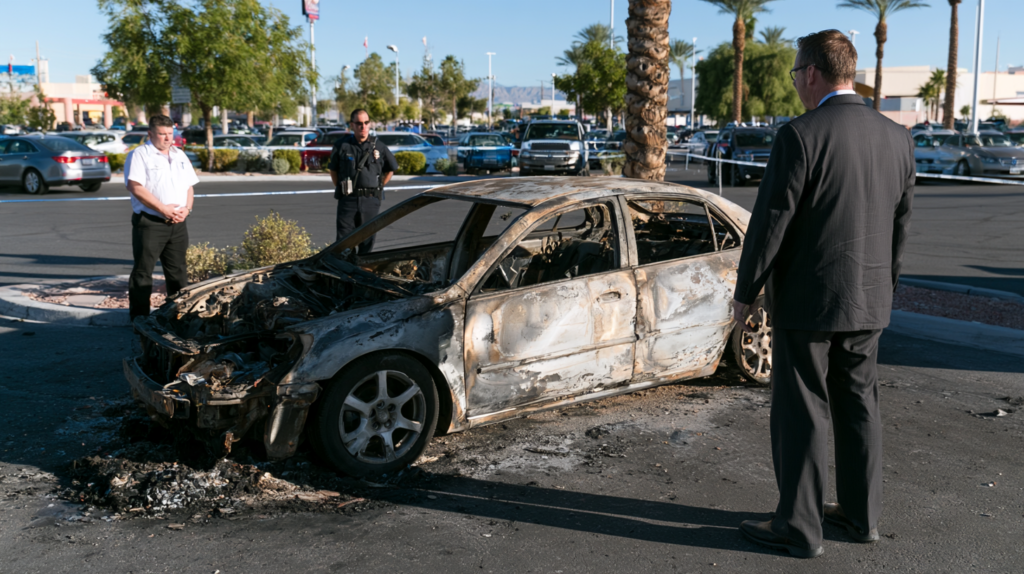
A fire that only damages part of an empty rental house can lead to a more serious charge than a blaze that destroys a large amount of open land or personal property. Nevada does not classify arson primarily by the size of the fire or the dollar amount of the loss.
The four degrees of arson depend mainly on what was burned and, in some cases, whether anyone was inside the property. A house, trailer, or occupied vehicle can lead to the most serious degree, while abandoned buildings, unoccupied property, open land, and attempted fires fall into lower categories.
Every Nevada arson charge requires willful and malicious conduct
Every degree of arson in Nevada requires proof that the defendant acted willfully and maliciously. Under NRS 193.0175, malice involves an intent or design to harm, annoy, or injure another person, and prosecutors may sometimes ask a jury to infer malice from wrongful conduct without a lawful excuse.
Nevada also uses a broad definition of what it means to set fire to property. Under NRS 205.005, it can be enough for any part of the property or something inside it to become scorched, charred, or burned. The structure does not have to be destroyed.
The arson statutes also apply to people who aid, counsel, or procure the burning, meaning a person who arranges or pays someone else to start the fire can face the same charge as the person who actually ignited it.
Our guide to Nevada felony categories A through E explains the felony classifications used in these offenses.
Nevada’s four degrees of arson depend on the property and the conduct
First-degree arson under NRS 205.010 covers the willful and malicious burning of a dwelling, structure, or mobile home, whether occupied or vacant, as well as occupied personal property such as a vehicle or boat. Ownership does not change the classification, so intentionally burning your own home can still qualify. First-degree arson is a category B felony carrying 2 to 15 years in prison and a possible fine of up to $15,000.
Second-degree arson under NRS 205.015 applies to the burning of an abandoned building or structure. It is also a category B felony, but the penalty is lower at 1 to 10 years in prison and a possible fine of up to $10,000. The status of the property can become a major issue because a vacant house, recently closed business, or foreclosed property is not automatically considered abandoned.
Third-degree arson under NRS 205.020 generally covers unoccupied personal property belonging to another person worth at least $25, a person’s own unoccupied property when another party has a legal interest in it, and certain fires involving timber, forests, crops, grass, vegetation, or other flammable material belonging to someone else. It is a category D felony carrying 1 to 4 years in prison and a possible fine of up to $5,000.
Fourth-degree arson under NRS 205.025 applies when a person willfully and maliciously attempts or prepares to set fire to property covered by the first three degrees, even if nothing ultimately burns. It is a category D felony and can include a fine of up to $5,000. Nevada law also allows the placement of flammable, explosive, or combustible materials to serve as evidence of an attempted fire, and NRS 205.055 provides that willful preparation directed toward burning a building can itself qualify as an attempt.
Burning your own property can still be arson in Nevada
Nevada law specifically rejects the idea that arson requires someone else’s property.
Under NRS 205.050, another person’s ownership is not required for a building or structure to become the subject of an arson charge.
That means intentionally burning your own house can still be first-degree arson.
For personal property, ownership becomes more complicated because third-degree arson can apply when another person holds a legal interest, such as a lender, co-owner, or lienholder.
Burning insured property can create a separate felony
Nevada also separately criminalizes burning insured property with the intent to defraud the insurer.
Under NRS 205.030, willfully burning or attempting to burn insured property with fraudulent intent can be a category B felony carrying 1 to 6 years in prison and a fine of up to $5,000.
The court must also order restitution when required.
Our guide to restitution and asset forfeiture explains how those financial orders can affect the sentence.
An insurance claim submitted after the fire can also create a separate insurance fraud allegation when prosecutors believe the claimant knowingly provided false or misleading information.
Our guide to unemployment and insurance fraud in Nevada explains how those charges work.
A death during arson can turn the case into first-degree murder
When someone dies during the commission or attempted commission of arson, the case can become much more serious.
Under NRS 200.030, arson is one of the felonies that can support a first-degree felony murder charge.
The State does not necessarily have to prove that the defendant intended to kill the person.
The prosecution instead may rely on the fact that the death occurred during the perpetration or attempted perpetration of the arson.
Felony murder can carry life imprisonment
First-degree murder is a category A felony in Nevada.
Depending on the circumstances, possible sentences can include life without parole, life with parole eligibility after a minimum period, or a lengthy definite sentence.
Our guide to felony murder in Nevada explains how a person can face murder exposure even when there was no intent to kill.
Nevada’s arson statutes themselves do not contain a separate injury enhancement short of death, so other criminal statutes may be charged alongside the arson when someone is injured.
Cause and origin evidence often decides an arson case
Most arson cases do not have an eyewitness who saw someone start the fire.
Instead, investigators often rely on expert analysis to determine the origin, meaning where the fire started, and the cause, meaning what ignited it.
Fire investigators may evaluate burn patterns, electrical systems, appliances, fuel sources, debris samples, and other physical evidence.
A defense expert can review whether those conclusions were properly supported and whether alternative accidental causes were adequately excluded.
Independent fire experts can challenge the State’s conclusions
An incendiary-fire finding often depends on a series of assumptions.
The investigator may rely on burn patterns, chemical testing, scene reconstruction, and the absence of another apparent explanation.
Each step can be challenged.
A defense expert can examine whether the scene was preserved correctly, whether testing was reliable, whether electrical or mechanical causes were ruled out, and whether the investigator followed accepted fire-investigation methods.
Our guide to expert witnesses in Las Vegas trials explains how expert testimony can be tested in court.
An accidental fire is not arson
Every degree of Nevada arson requires a willful and malicious act.
An accidental fire therefore does not satisfy the elements of arson.
Nevada separately addresses negligent or careless fires under other statutes.
Those offenses can cover conduct such as failing to extinguish a fire properly, leaving a campfire burning, or discarding a lit cigarette where it can ignite property.
The difference between negligence and malice can determine whether the case is treated as a misdemeanor-level fire offense or a felony arson prosecution.
Grossly negligent fires can still create serious consequences
Nevada law also addresses fires started with gross negligence in open areas.
When such a fire destroys another person’s timber, vegetation, crops, or property, the criminal classification can depend on the value of the loss.
Civil liability can also follow.
The distinction between a negligent fire and a malicious one therefore becomes a central defense issue, and the cause-and-origin evidence often determines which theory prosecutors pursue.
Statements made during the investigation can affect the case
Fire investigators may ask questions about insurance, finances, property disputes, or where the defendant was before the fire.
Those questions can be aimed at establishing motive, opportunity, intent, or knowledge.
Our guide to what to do before talking to police explains why statements should be handled carefully.
A felony arson case may also proceed through a preliminary hearing in Clark County, where the defense can begin challenging the investigator’s conclusions.
Frequently Asked Questions
What degree of arson applies to setting fire to a car in Nevada?
It depends on ownership and occupancy. An occupied vehicle can support first-degree arson. An unoccupied vehicle belonging to someone else and worth at least $25 can fall under third-degree arson. A person’s own vehicle may also qualify when another party, such as a lender or co-owner, has a legal interest in it.
What happens if a fire spreads to a neighbor’s home?
Nevada law can treat the spread of the fire as part of the original act. Under NRS 205.045, if a building is endangered by a fire and later catches fire from it, a person responsible for the original fire may also be treated as having set fire to the additional structure.
Is threatening to burn someone’s property considered arson?
A threat alone, without an attempt or preparation, is generally not arson under Nevada’s arson statutes. Depending on the circumstances, it may support another criminal charge. Once someone gathers materials or takes a substantial step toward setting the fire, the conduct may move into fourth-degree arson.
Conclusion
Arson charges often depend heavily on expert conclusions that are still developing after the initial arrest. Whether the property was abandoned, whether another person held a legal interest, whether the fire was accidental, and whether the investigator correctly identified the origin and cause can all affect the charge.
The difference between first-, second-, third-, and fourth-degree arson can significantly change prison exposure, and related allegations involving insurance, injury, or death can make the case even more serious.
If you or someone in your family is facing an arson investigation in Nevada, contact The Defense Firm for a free confidential consultation. A Las Vegas criminal defense lawyer can review the cause-and-origin investigation, property classification, expert evidence, insurance issues, and statements made to investigators before the prosecution’s theory becomes fixed.